

Pop Power
On public planning and popular agency
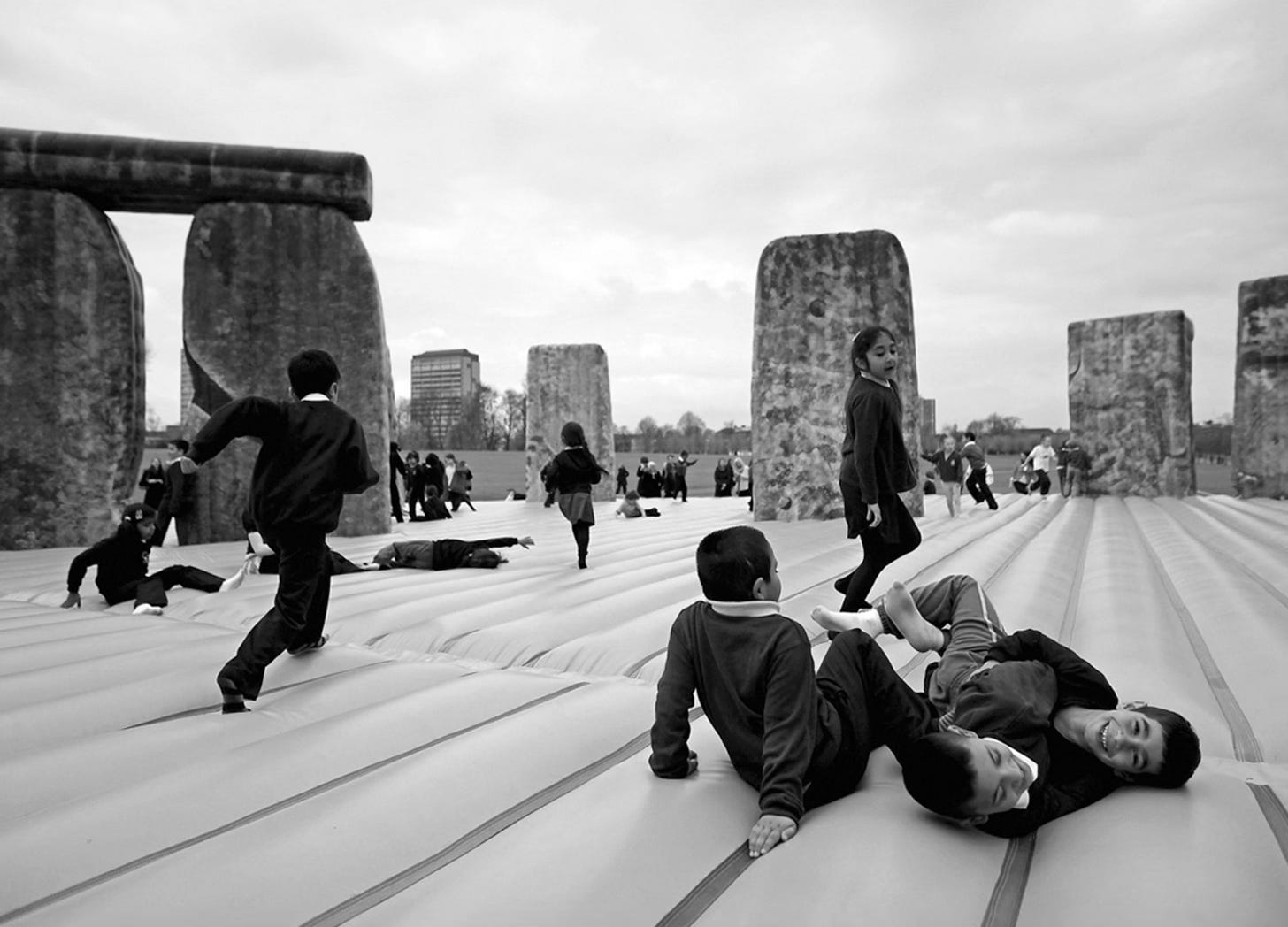
Here I use cultural theory (including a brief digression into the politics of ripped denim) to set up a potential productive relationship between ‘what people build and dream of building’ and the more formal end of the planning system.
This is a text adapted from my unpublished PhD, ‘Making Planning Popular: popular agency, online discourse and English statutory planning’ (Royal College of Art 2018). The text was originally extracted for the benefit of students of ADS2: The Popular, taught by myself, Diana Ibáñez López and Finn Williams.
Popular culture, seen in relation to wider systems of power and agency in the built environment, can be understood as a progressive political tool and as a site of mediation in which power and agency can be gained. After decades of antagonism and duality-based theory (‘wemust advocate’, ‘they must participate’) which if anything has served to reinforce the division between public planning and society, it is highly overdue that we recognise these antagonisms and binaries as part of a wider (difficult) whole, and one that might form the basis of a more open, progressive system of deciding the future of the environment.
The assertion that ‘popular culture’ might provide political power to ‘the people’, is rooted in the work of Antonio Gramsci (1891-1937) whose idea of cultural hegemony was a way of understanding the means through which power is gained by class groups and, ultimately, how power might be gained by the proletariat in the context in which he was writing, that of the Italian Fascist dictatorship of 1922-1945. In Gramsci’s thought, the hegemony of a given political class meant that ‘that class had succeeded in persuading the other classes of society to accept its own moral, political and cultural values’ (Joll, 1977: 8,99) thereby asserting leadership. The role of the intellectual in this process, for Gramsci, is of vital importance, as the gaining and maintaining of hegemony is largely a question of education: ‘Every relationship of “hegemony” is necessarily a pedagogic relationship’ (Gramsci, 1971:350), and as such it is through a process of education – a necessarily gradual one - that cultural hegemony is achieved. In terms of gaining power for the currently dominated classes, in Gramsci’s terms a ‘popular national bloc’, it is vital that the intellectuals undertaking the construction of a collective will through education do so in a way that is profoundly engaged with those dominated classes, what Joll described as the ‘test of common sense’ (1971:101).
In this way, Gramsci proposed that political leadership was not simply a question of economic power but also of cultural and moral dominance, and established a terrain where cultural production - high or low, art, literature, music - can be conceived of as having agency within a political system, and moreover having a mobility within class structures. Such thinking would lead, eventually, to Gramsci’s strong influence over the fields of cultural and pedagogical theory, particularly (in this context) after his Prison Notebooks were translated into English in 1971.
In the field of cultural theory, Gramsci’s conception of cultural hegemony allowed a generation of cultural theorists (among them Tony Bennett, John Fiske, George Rudé, Stuart Hall and Raphael Samuel) to explore the workings of popular culture and activity as, in Bennett’s terms,
an area of negotiation between [an imposed mass culture that is coincident with dominant ideology] and [spontaneously oppositional cultures] …within which… dominant, subordinate and oppositional cultural and ideological values and elements are ‘mixed’ in different permutations. (1986: xv-xvi)
Through their work, the importance of popular culture in society was revealed to have been underplayed. Its depictions in political discourse up to this point had mainly been negative or abstract, portraying ‘the people’ as either passive receivers of culture or unruly rebels.
It was only in the 1970s and 80s, thanks to this generation of theorists and historians, that popular culture’s role in social and political processes, ‘particularly those bearing on the production of consent to the prevailing social order’, began to be given serious attention by sociologists and cultural theorists. Within this discourse at least, portrayals of ‘the people’ accordingly became more nuanced and precise, and the notion of popular culture as a subject of serious study became widespread, built upon foundations laid by of social historians like Raphael Samuel. Samuel’s History Workshop (1966-) pioneered ground-up social history, including oral history, in the UK, with the stated aim of making the production of history a collaborative enterprise ‘that could be used to support activism and social justice, and inform politics.’
Bennett was able in this period to retrospectively trace a lineage of practices, in the work of Gramsci, Brecht and Bakhtin, which produced ‘a new sense of “the popular” as the site of a critical and speculative intelligence’, though acknowledging that these practices had hitherto not even impacted upon mainstream politics (1986:14-15).
The emergence of popular culture as worthy of academic attention can be understood as a reaction to three related phenomena. Firstly, to the highly effective use of popular narratives in the 1970s by the New Right; secondly, as an attempted corrective to the Left’s failure to engage meaningfully with such narratives since the immediate post-war years; and thirdly, as a reaction to the growing impact, unpredictability and dynamism of popular cultural forms from the late 1950s onwards. These phenomena will be considered in turn.
The New Right gained a great deal of political ground through its use of popular rhetoric (Fiske, 1989:188) in a form characterised by its highly generic evocation of ‘the people’, in some instances weaponised against a group which might more obviously be considered of the people too. Stuart Hall, quoting Thatcher directly, offered a telling example in 1981:
“We have to limit the power of the trade unions because that is what the people want.”
Who are the people, Bennett asks? Are some of the people not trade unionists themselves? Is the government in this example really proposing to follow, blindly, the wishes of an assumed majority?
Theorists of the 1980s therefore identified the Left’s disconnect from popular culture as a crucial factor in its losing not only a political but a cultural battle in the late twentieth century (Bennett 1986:6). The Left had not only abandoned a populist discourse but did not seem to realise it. The situation led cultural theorist John Fiske, in the US, to propose that ‘left-wing theorists need to explore the conditions under which the submerged 90 percent of the political iceberg can be made to rear up and disrupt the social surface’ (Fiske 1989:162).
Alex Niven, writing in 2012, found that the ‘tragic rupture’ between Leftist politics and popular culture was still present, and had not been addressed by New Labour (Niven, 2012:67-8). Hilary Wainwright, in her studies of experiments in global participatory democracy found that, in Manchester regeneration projects of the New Labour era, voluntary groups and resident’s forums were ‘misleadingly assumed to be homogenous’, an unsophisticated characterisation of what must have been combative and dissenting popular organisations in a highly politicised context (2003:81). If the Thatcher government made the people generic for its own ends, the New Labour project kept them so.
Alongside their calls for politicians and policymakers of the left to re-engage with popular culture in order to address what they perceived as the ‘ghettoisation’ of socialist ideas, theorists of popular culture examined the reasons underlying the Left’s apparent disinterest in popular desire. Bennett (1986:9), found that Marxist conceptions of the popular are too often limited by two apparently contradictory impulses which he terms ‘walking backwards into the future’ and ‘ideal futurism’. In the first instance, Marxist theory tends toward deploying ‘historically superseded forms’ as models for the future without modifying them for use in the present. In the second instance, theories are composed to address an idealised people of a ‘projected socialist future’. In both cases, a form of Utopianism takes the place of an engagement with how things (and people) are in the present tense, and the people of today are found wanting by comparison to both the past and the future.
The third and final of the reasons behind cultural theory’s increasing engagement with the popular and with popular culture in the 1970s and 80s was that the culture itself had become hard to ignore since the technological and social advances of the post-war ‘golden age’, a turning point in the history of which were the 1968 student riots in Paris and elsewhere. For Alex Niven, this period saw the popular take on an active role as a progressive, if not revolutionary force in political and societal change, largely independent of mainstream politics in the UK and elsewhere; ‘the voiceless… finally finding a voice’ (Niven, 2012:17). This voice, for example, had a measurable impact on the growth of the environmental movement, which was born not out of governmental policy or academic research in the traditional sense, but out of counter-cultural groups (2012:37). For Niven, this alternative ‘golden age’ of an influential popular culture was nothing more or less than a moment when popular desire transcended its usual subjugation by the rich and powerful. These movements had a real if indirect role in the adoption of ideas of ‘participation’ within planning law and policy such as the UK’s ‘Skeffington’ report of the late 1960s.
But what potential does the ‘popular’ have to contribute to political change, or to become a political space? By turning to the work of John Fiske (1939-), a cultural theorist concerned with the mechanics of popular culture and explicitly with addresses the Left’s failure to engage with popular desire, I will attempt a provisional answer to these questions.
Fiske’s notion of society, which rejects grand narratives in favour of a more contradictory and fundamentally popular model, forms a useful basis on which to understand the popular and reconnect it to mainstream political processes. For Fiske, the history of Western society is characterised by ‘constant conflicts in which all victories are partial, all defeats less than total’ (Fiske, 1989:180, a conception which strongly echoes the work of both Colin Ward and Chantal Mouffe) For Fiske, this history is revealed by the (then) growing discipline of social and popular history, and he particularly cites the work of cultural historian (and Project Gutenberg founder) Robert Darnton, whose book The Great Cat Massacre and Other Episodes in French Cultural History (1984) focussed attention upon the resistant practices of printing apprentices in early eighteenth century Paris. Fiske asserts that
Our social structure, our oral culture, our cultural resources are indelibly inscribed with the contradictory traces of these oppressed, but not eliminated, social formations. (Fiske, 1989:180)
These formations form the basis of popular culture, and draw attention away from the utopian impulse for ‘total revolution’ and toward a model of power redistribution based upon constant renegotiation and adjustment. He therefore distinguishes ‘popular culture’ from ‘mass culture’ – in his terms the latter is what is produced by an industrialised, capitalist society and the former is how people use or abuse that product.
Accordingly, Fiske asserts that popular culture is not a ‘stable sociological category’ but instead embodies ‘a shifting set of allegiances’ (1989:25), which give it its resistant role in societal change. He also proposes that a function of the popular can be its capacity to appropriate from the powerful for political gain. Fiske defines this technique as excorporation: ‘the process by which the subordinate make their own culture out of the resources and commodities provided by the dominant system’ (Fiske, 1989:15).
If we take the earlier proposition that the popular is a territory of adjustment and renegotiation, in a society which is also characterised by endless renegotiation, then Fiske’s notion of excorporation is the process through which elements of the dominant system enter the domain of the popular and emerge transformed. This suggests that any study of popular culture must look at, and differentiate, what is received by people and then what is produced or used out of what is received. Like Stuart Hall, Fiske proposes that such a study should ‘always start with “the double movement of containment and resistance, which is always inevitably inside it’ (1981:228, cited in Fiske, 1989:28-9), wherein resistance, to take an example from fashion, is ‘tearing or bleaching of one’s jeans’ and containment is ‘the industry’s incorporation of this into its production system’ (1989:29).
Fiske asserts that this process allows for adjustments to the status quo, not merely a return to the balance of before. This micropolitical change must not be underestimated, concerned as it is with ‘the day-to-day negotiations of unequal power relations in such structures as the family, the immediate work environment, and the classroom’ (1989:56). He offers the of-its-time example of how Madonna might be ‘used’ by a fan in ways that empowers the fan- maybe through torn jeans again. This empowerment can impact in many powerful ways on the individual fan and upon her wider society, for instance through an impact on the relationships within the fan’s family or working life (1989:191). Popular culture cannot therefore be strictly radical and for Fiske it is best described as progressive (1989:21) or, Fiske’s critics might assert, potentially progressive. It ‘finds in the vigor (sic) and vitality of the people evidence both of the possibility of social change and of the motivation to drive it.’ (1989:21)
Fiske’s optimism with regard to the use of popular culture is partly built upon his definition of the wider society in which it takes place, but it is also because he is suspicious of the process by which radical change might happen. Building on the work of de Certeau (1985), Fiske asserts the importance of guerrilla tactics as weapons of the ‘weak’, in contrast to ‘open warfare’, which they will always lose. The story of the ‘use’ of Madonna is, for Fiske, one example among many of ‘individual women, in their everyday lives, constantly [making] guerrilla raids upon patriarchy’ (Fiske, 1989:20).
Critics of Fiske’s approach might assert that the products of popular culture are not necessarily empowering in the way that Fiske asserts, and that products of the dominant culture are increasingly designed to allow for a degree of excorporation within limits defined by the powerful. To this, Fiske argues that the nature of excorporation is inherently occasional and irregular. Popular culture might lie dormant or repressed for much of the time, but this does not limit its potential to transcend this condition. ‘Resistance fighters,’ Fiske asserts, ‘are law-abiding citizens much of the time’. His analysis of popular culture therefore takes practices as its location rather than specific texts or individuals (1989:45), and asserts that the ongoing process of subordination and insubordination is sustained from within the popular (1989:169).
Perhaps the techniques of popular culture are best understood as individual acts (i.e. micropolitical), though sometimes united against a common dominance. This distinguishes popular culture from folk culture, a form which Fiske finds impossible in an industrialised society anyway but which, when it was possible, had the potential for ‘solidarity’ which popular culture does not (1989:173). Popular culture can of course, be sociable and therefore collective, the Madonna fan of Fiske’s example can benefit, or not, from engagement with others with similar uses for the ‘original’.
Fiske is highly aware, therefore, of the limits of popular culture as a tool of political change, and adopts a pragmatic attitude to its use in relation to societal and political change. He nevertheless proposes a ‘reconceptualization of popular forces as an untapped social resource that can fuel… the motor of social change’ (1989:193), conjuring an image of a multitude of micropolitical actors, each individually but socially alchemising the products (or texts) of the dominant culture.
What if, in the place of a new song or text, we considered the ‘products’ of public planning –A4 lamp-post notification, policy, consultation, communication with a duty officer, permission or denial in the form of a letter, condition, and indeed (probably most importantly) a permitted, approved and built structure – as cultural products, forms of media/mediation?
Following Fiske et. al, and refusing to make political value judgements on the basis of the original cultural product, is it possible to imagine the popular usage and abusage of these cultural products having a micro-political progressive impact on the system itself? Does this already happen?
For sociologist Herbert Gans, the potential agency of popular activity in relation to hegemonic structures and apparata is not simply a question of recognizing the existence of those phenomena within a larger system of cultural production, it is also a question of the limits of those apparata. Considering the professionalism of the architect, Gans wrote in 1977:
Other professionals [to architects] also supply only a minor portion of the product or service over which they claim expertise… Medical aid is probably still administered more often by druggists and relatives than by doctors, just as most counseling is done by ministers, relatives, and friends rather than by trained social workers or psychiatrists. (Gans, 1977:26)
Gans situates architectural production by architects within the realm of high culture, therefore constrained by an antagonistic relationship to low or popular culture. He proposes that this relation, like in the medical profession, is substantially defined by the style and approach of the practitioner: ‘Doctors often treat patients as collections of diseases rather than people, and , like sociologists and social workers, supply their services in a technical language that puts off their patients and clients.’ (Gans, 1977:26).
Public planning can, in this light, be seen as the formal, professionalised ‘part’ of a larger system of production and discourse in which wider popular agency is also a protagonist.. The ‘discovery’ of this larger system offers a reconception of the processes of cultural production that has implications for understanding the agency of popular activity in creating, maintaining and shaping those processes: in short, the stage is set for a productive series of guerrilla raids on the ‘formal end’ of how we produce the built environment or, if the built environment industry has a large enough heart, for the formal system to open itself up to such agency in the name of a system where more people, and more diverse people, have genuine voice and power.
Bibliography
Bennett, Tony. ‘The politics of the popular’, in Bennett, Tony, Colin Mercer and Janet Woollacott (1986) Popular Culture and Social Relations. Milton Keynes: OUP, pp. 6-21.
Coben, Diana ‘Revisiting Gramsci’ in Webber, Michelle, and Kate Bezanson (eds.) (2012) Rethinking Society in the 21st Century: Critical Readings in Sociology.
Darnton, Robert (1984) The Great Cat Massacre and Other Episodes in French Cultural History. New York: Basic Books.
De Certeau, Michel (1985) The Practice of Everyday Life. Berkeley: University of California Press
DoE (Department of the Environment) (1969) People and Planning: Report of the Committee on Public Participation in Planning. London: HMSO.
Fiske, John (1989) Understanding Popular Culture. London: Routledge.
Gans, Herbert J. ‘Toward a Human Architecture: A Sociologist’s View of the Profession’, Journal of Architectural Education Vol. 31 No.2 (November 1977): pp. 26-31.
Gramsci, Antonio, (eds. Quentin Hoare and Geoffrey Nowell Smith) (1971) Selections from the Prison Notebooks. London: Lawrence & Wishart.
Hall, Stuart. ‘Notes on deconstructing the “popular”’ in Samuel, R. (ed.) (1981) People’s History and Socialist Theory. London: Routledge, pp. 227-239.
Hall, Stuart. ‘Popular culture and the state’, in Bennett, Tony, Colin Mercer and Janet Woollacott (1986) Popular Culture and Social Relations. Milton Keynes: OUP, pp. 22-49.
Joll, James (1977) Fontana Modern Masters: Gramsci. London: Fontana.
Mouffe, Chantal (ed.) (1979) Gramsci and Marxist Theory. London: Routledge & Kegan Paul.
Niven, Alex (2011) Folk Opposition. Winchester: Zero.
Samuel, Raphael (ed.) (1981) People’s History and Socialist Theory. London: Routledge.
Wainwright, Hilary (2003) Reclaim the state: experiments in popular democracy. London; New York: Verso.